
Hope, Hell, Humanity: The Holocaust.
A brief retrospective on Mahirah, Esme, Anastasiya and Zahra’s trip with Lessons From Auschwitz
The definition of the “Holocaust” varies depending on whom you ask. One succinct answer to such an atrocity cannot be decided because of how unfathomable the devastation and cruelty was. So, when we first joined the course and that was the first question we were all asked, our answers varied along the lines of:
“The systemic murder of six million Jews during WWII.”
We continued filling out the online courses, jotting things down until Sunday 1st February, when we all headed to the seminar to learn about what we would do on our trip to Poland, as well as hear the testimony of a holocaust survivor.
After introductions, we separated into group. The four of us sat in a circle with the other students and our guide posed the question once again: “What was the Holocaust?”
We compared multiple official definitions from various organisations, and we concluded that to surmise such horror is not an easy task. Who do you blame? When did it start? Who was affected? These questions appeared and were embedded into our minds as we continued our journey.
Something emphasised throughout the seminar was the focus on the people who were affected. Each person who was prosecuted had a dream, a life, a name- and they are not just part of an incomprehensible statistic.
Once we returned to the auditorium, we met John Dobai Janos. He was born 06/01/1934 in Budapest, Hungary and he was a survivor of the Holocaust.
“We lived a peaceful life,” he began as he displayed photos of his parents and his childhood home. He told us the population of Hungary was 10 million and 5% were Jewish and that Antisemitism formed over time with Nazi propaganda blaming Jews for the result of WW1. At first, discrimination came in the form of denying higher education, wearing the star of David, having a curfew and not being able to teach or have a business. The moment the changed hit him, he remembered clearly. “I cannot describe the horror of the moment when my school mate called me a ‘Dirty stinking Jew’.”
“Over 400,000 were sent to camps. Very few came back,” he explained. People packed up their belongings, and he would have been one of them if a Swedish Diplomat hadn’t made certificates declaring him, his father and his mother as neutrals. But, in the Autumn of 1945, after the Nazi’s lost power, the Hungarian government remained depraved. A memorial on the river running through Hungary depicts shoes, each symbolising a person who was lined up and shot down with machine guns; the river itself became an efficient mass grave.
As we made our way to the first camp, we passed through the small Polish Town of Oswiecim which was also renamed Auschwitz when Poland became German occupied during World War 2, with the camps situated on the edge of the town.
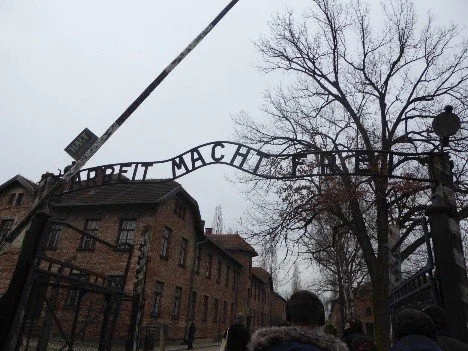
Our first destination was Auschwitz 1, which was the first main sector of the camp where predominately Polish political prisoners were kept. As we walked in through the entrance, which had a sign above, ‘Arbeit Macht Frei’ which translates into ‘Work sets you free’. This sign created false hope for prisoners and Jews who came into the camps thinking that they had come to work not knowing that the real aim was to never let them leave alive. As we kept on walking further into the camp we were caught between rows and rows of buildings where prisoners were kept, surrounded by wired fencing and watch towers.
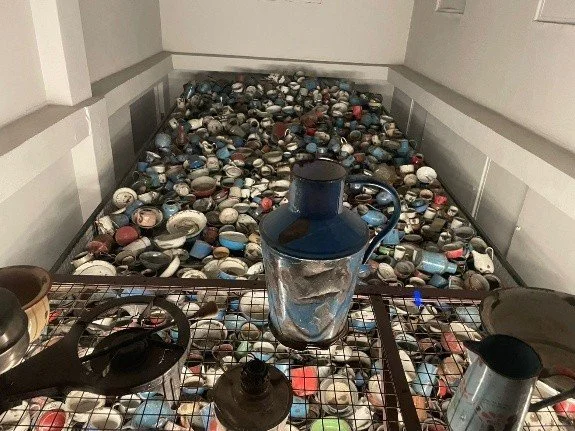
One of the buildings that we entered, had been turned into a small museum that displayed piles of personal belongings that once were property of innocent Jewish civilians. We saw piles of glasses, prayer cloths, combs, prosthetics used by disabled people and pots and pans. When disabled people entered the camp they were thought of as ‘useless’ as they couldn’t do any physical work for the Germans and so they were immediately sent to their deaths. Furthermore, the pots and pans in the pile mainly consisted of three main colours red, blue and white; this is because Jews had to use specific colours to be able to separate milk and meat as they are forbidden to be eaten at the same time. However, the most harrowing part was seeing the piles of hair because although the objects were personal to the Jews, their hair was physically a part of them and made them human and by stripping this away from them Jews were being completely dehumanised and reduced into nothing. They collected the hair to sell it to German companies to be used as an industrial material.
On the 13th January 1945, John recalled soldiers arriving at his home and his father speaking in Russian, allowing them to survive. He recalled his first birthday after the war: “For my birthday, I was given horsemeat because we were starving.”
When asked why he tells his testimony, John answered, “I’m doing this because I want to remember my two aunts, my cousin, my neighbours, those who were mentally and physically handicapped for the designations forced on them […] Don’t forget these people.” He replied instantly when someone asked him what kept him going despite the anguish: “Hope. The love that existed between my mother and father and myself.”
He admits how he feels about survivors’ guilt: “It is a huge burden.” After the war, he and his family moved to Britain, where he remained silent because, “Our neighbours didn’t appreciate what happened. So, I decided not to speak about what happened. This country gave us a good, happy life.” However, once he retired, he had time to reflect and believed that if he could go back in time to the young boy he was, he would say: “Stand fast. Stand fast; you will get through it with the love for your parents.”
He looked around the auditorium, at us. We would be the last generation to hear from a survivor of the holocaust, and a feeling of admiration filled the room. Not because he was a hero, but because he is a man who loved and loves despite the horrors he experienced.
“I have not forgotten, but I am ready to forgive because if you don’t, you get a corrosion in your head. I will always remember,” John declared before he told us “Do not let an expression of hatred to go unnoticed,” and that “We are all a part of the human race.”
As a people, it is our duty to not just remember but prevent the tragedies and atrocities of the past, because systemic oppression perseveres when a bystander allows it to. It was not just Nazi Germany that killed six million Jews, but it included the collaborators that allowed, funded and accepted that incomprehensible devastation.
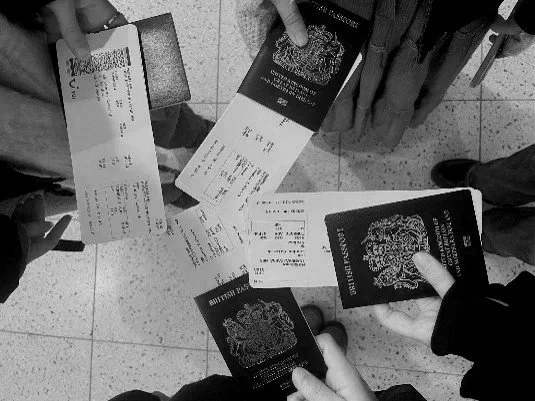
So, on Wednesday 4th February, we flew to Krakow, Poland to witness first-hand the devastation of the holocaust.
- Mahirah Kashem.
One of the most prominent parts of the camp was entering the building, Yad Vashem, which is a part of the Holocaust memorial and archives. As you walk in, you hear a song playing in the background, called ‘Someone’ which is a poignant piece of music sung in Hebrew reflecting on the memories of those who were lost during the Holocaust and serves as a reminder of the victims suffering and hope. Yad Vashem in Auschwitz 1 was created to commemorate the six million Jews who were murdered during the Holocaust and the Book of names serves as a record of the victims. However, the Book of Names only records about 4 million Jewish victims because some of those who have been lost still remain unknown but not forgotten.
Before leaving the first camp, we lastly discussed Rudolf Hoss, who became the appointed commandant of the newly built camp at Auschwitz in early 1940. Hoss lived in the camp full time with his family and enjoyed his privileges and freedom as the head leader of the camp. He was responsible for turning Auschwitz into an extermination camp and installed gas chambers and crematoria that could kill 2,000 people every hour.
After being told these facts, we were asked a question: why would Hoss bring his family to such a harrowing place? Perhaps the prestige of living with such a high status, perhaps it was to gain a higher favour with the Fuhrer but ultimately, we concluded that he simply loved his family and couldn’t be parted from them. This reflects on this wholistic idea that history is not black and white. There are nuances; No one is good nor bad and instead, these were purposeful choices made by these people.
In 1945, Hoss went into hiding in Germany when the war was coming to an end, but he was caught and arrested in 1946 by the allied military police who handed him back to the Polish authorities. In 1947, Hoss was tried and was sentenced to death. He was returned to Auschwitz to be hanged outside the entrance to the gas chamber. At the site there was a replica of the stand where he was hung next to the gas chamber.
Then we passed through the inside of the gas chamber which was originally designed to look like a shower to trick Jews into not knowing that they were being sent to their deaths.
From here we then travelled over to Auschwitz-Birkenau, the second camp.
- Zahra Ivanova.
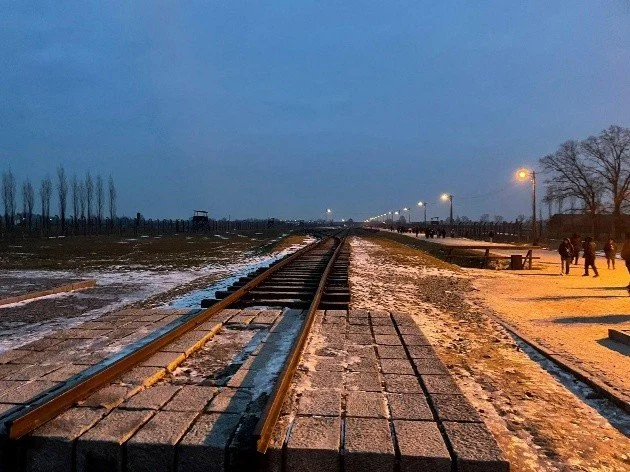
After a brief 5-minute coach journey, we arrived at Auschwitz II Birkenau. While it was a short, comfortable journey for us, we were reminded to reflect on how traumatic and harrowing the journey to this camp was for millions of people, coming from thousands of miles by train, truck, and even foot, which was further underscored to us when the infamous train tracks came into view, leading straight into the camp.
Instantly upon arrival to Auschwitz II Birkenau, we could agree that the most haunting element of this camp was the sheer size of it. As we stood on the train tracks outside the central entrance, our educator encouraged us to look to both ends of the camp. The walls stretched so far that it was impossible to see either end, a powerful reflection of how eternally trapped the prisoners will have felt upon arrival and during their time at Auschwitz II Birkenau.
Another factor that we experienced at the second camp which further intensified our connection and understanding with the victims of the Holocaust, it was the weather. Despite being a fairly mild day of Polish wintertime, at zero degrees Celsius, the cold was overbearing and all consuming. It was almost impossible to imagine that not only could temperatures reach -40 degrees Celsius (as the Polish winters of the 1940s were some of the coldest in European history) but also that the prisoners of Auschwitz II Birkenau were not even a fraction as prepared for the cold as we were, wrapped up in coats, scarves and gloves, while the prisoners would have been lucky if they had more than a layer of thin cloth. Even after this unbelievable experience and insight, our tour stated that, in fact, the prisoners tended to prefer the winters at Auschwitz, due to the immense intensity of the summers in Poland, rich with disease, dehydration and exhaustion.
At the gates of the camp, we were met with our same tour guide from Auschwitz I who proceeded to take us on a similarly enlightening and educational walk of the grounds, however, despite spending a few hours here, the surface of the vastness of this camp was barely even scratched. We toured through the remaining barracks and were told about the day-to-day life for the prisoners, demonstrated through the displays of packed, rickety bunkbeds in one building, alongside the dehumanising, torturous conditions of the latrines in another. The physical presentation of these barracks not only further exposed us to the atrocities committed and experienced during the Holocaust but also deepened our comprehension of the suffering and tragedies of the prisoners. Our tour guide continued to walk us farther into Auschwitz II Birkenau, along the perpetual train tracks which ran directly through the centre of the camp, all the way to the remains of the gas chambers. Here, our tour rounded up with a discussion and consideration on the history, legacy, and significance of Auschwitz.
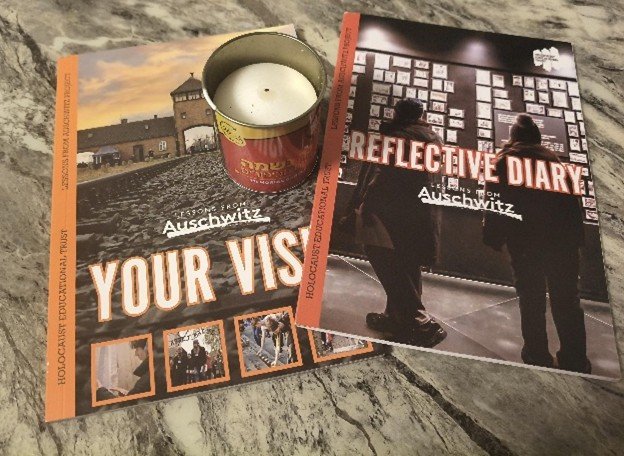
By then, night had fallen and whilst we all shivered, everyone gathered with Rabbi Akiva Rosenblatt at the back of the camp for a time of reflection on the day we’ve had. He said a prayer and some were chosen to read poetry and light a few candles in order to remember that the traditions of the Jewish people remain- like an undying flame.
It was really prevalent throughout the group how impactful and influential the Rabbi’s talk was. He rounded up the day with a reflection on what we had experienced and learnt across the day, and talked us through our next steps moving on, and how we can apply our education to the people around us and the rest of the world. He emphasised how with the shock combined with the nature of the bombardment of testimony and tragedy, it was natural to be feeling numb and overwhelmed. Often, when we learn about history, we forget that these events are real and that this all took place not even a lifetime ago. Most importantly, the Rabbi stressed the importance of hope- especially in times like the extreme tragedies of the Holocaust, and in the frightening political climate of the current day.
- Esme Hoxley.
In conclusion, listening to the testimonies and visiting Auschwitz was an incredible opportunity for us.
We were not only filled with knowledge but also surrounded by evidence and a devastatingly sombre atmosphere. By experiencing history in a uniquely deeper way, that cannot be replicated in a classroom, our minds were opened.
It was a harrowing yet educational day.
We reflected on all the families involved within the holocaust, remembering the names and individualities of the victims. We were encouraged to take time to unravel the truly unimaginable suffering. Instead of pure statistics, the life stories we had access too were emphasised because in order to understand the tragedy, you must acknowledge what once was.
They stressed that knowing that six million Jews were killed wasn’t nearly as important as recognising the children, the mothers, the fathers, the brothers, the sisters- the experiences that simply can’t be represented by a number. It is important that the younger generations continue to learn about the holocaust to honour the millions of lives lost. It is our duty to ensure that no suffering can be forgotten and by showing the issues with antisemitism and discrimination, we are to challenge it. As history students, it reminds us that these events are more than the paragraphs in our textbooks. We need to be able to gain a deeper emotional understanding to fully comprehend it. Therefore, making this entire experience invaluable, haunting yet enlightening, and we shall always continue to reflect on with the future to come.
- Anastasiya Lysyshyn
“Do not let an expression of hatred to go unnoticed. […] We are all a part of the human race.”
- John Dobai Janos.